LSAT Summer Prep Class for Low-Income Students
Faculty of Law LSAT Summer Prep Program
Generously sponsored by Borden Ladner Gervais LLP
Prospective law students from low-income backgrounds may once again be eligible for the LSAT Summer Prep Class at the University of Alberta Faculty of Law. This 12 week virtual course provides free support to students who plan to write the Law School Admission Test (LSAT).
Generously funded by Borden Ladner Gervais LLP, the LSAT Summer Prep Program is available to low-income, high-potential students who qualify according to guidelines established by the Law School Admission Council (LSAC).
About
The program prepares students to write the October LSAT and is taught by a current University of Alberta Faculty of Law student.
Running from June 2 until August 20, classes will be held online twice a week on Tuesdays and Thursdays, 6 - 8 p.m. (MDT). Participants must commit to attend at least 90% of the classes. Attendance will be checked throughout the program. Students should also be prepared to devote 2-5 hours each week to self-study and/or practice exams. Participation in the U of A’s LSAT Summer Prep Program is capped at 20 students.
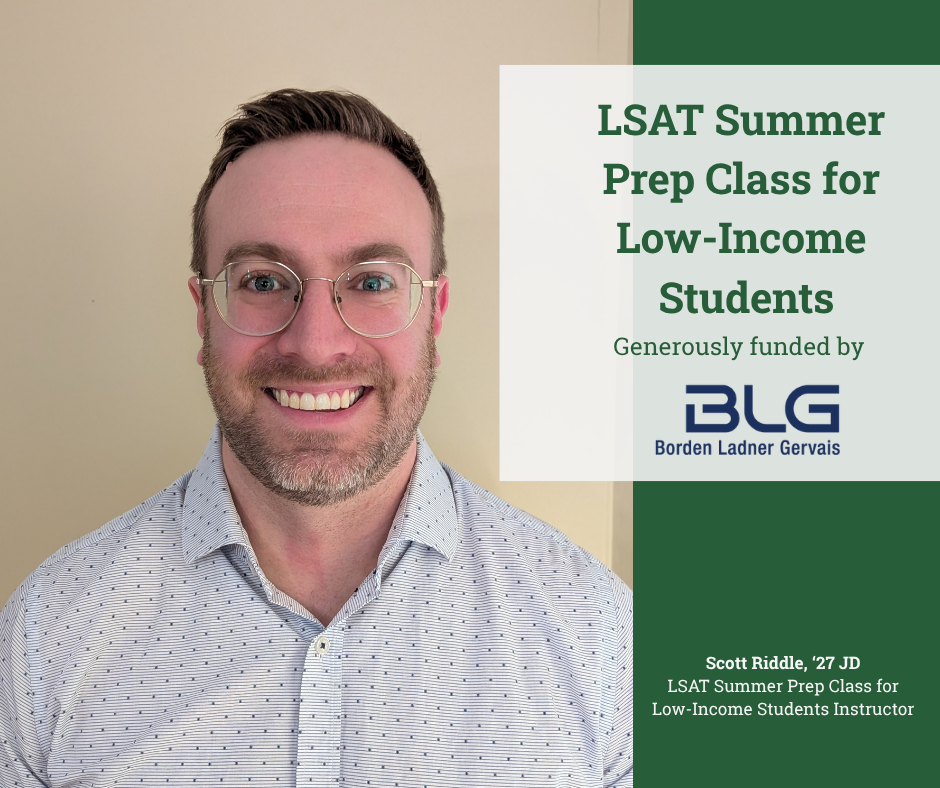
"I am very lucky to have taught the LSAT Prep Course for 2 years. This 3-month course gives low-income students a chance to prepare for the LSAT and gives them a community of people who are all working towards the same goal of being accepted into law school. The LSAT has a high barrier to entry in not only the skills required to succeed but also the funds that are needed to access tutoring and the test itself. Taking the test itself costs over $350, and prep materials can cost hundreds more," says instructor, Scott Riddle, '27 JD.
"We practice skills of all sorts related to the LSAT and test-taking, including logical reasoning, reading comprehension, test-taking speed, but also wellness and mindfulness. I aim to teach students not only what to practice, but how to practice in such a way that will prevent burnout and lead to a positive mindset on test day. BLG's support of this program is incredibly important to reducing the barriers to entry for law school and promoting a wider diversity of experiences in our law school cohorts."
Eligibility
Students must be enrolled in or have completed an eligible undergraduate degree program. You do not need to be a University of Alberta student or alumni.
Applicants to the program must be a Canadian Citizen, Permanent Resident, or Protected Person.
To qualify for the program, students must first apply to the Law School Admission Council for a waiver of the LSAT fee. This waiver must be approved in order to be eligible for the program (note that applications can still be submitted if a decision on the waiver has not yet been made). If they also meet LSAC’s eligibility criteria, students may then apply for the Faculty’s prep program. Sign up for an LSAC account and apply for the fee waiver.
How To Apply
- Completed application form;
- Proof you have received or applied for an LSAC fee waiver;
- Transcripts from any post-secondary institutions you have attended; unofficial or student copies of transcripts will be accepted; and
- Statement of Interest (maximum 500 words)
- What makes you a strong candidate to obtain a legal education?
- What do you want to do with your law degree?
- Are there any obstacles to achievement (academic, personal, financial, etc.) you have faced?
Questions? Contact Amna Tamkin, student recruiter/funding advisor, at law.recruiter@ualberta.ca.
Thank you to the University of Calgary Faculty of Law and University of Toronto Faculty of Law for their assistance in setting up this program.
Program Benefits
- Receive wise advice and comprehensive training on how to excel at the LSAT
- Gain a deeper understanding of law school admissions and how to fund your law degree
- Connect with current law students and legal professionals while getting valuable exposure to law school and the profession
- Access study materials, practice tests and additional study group support
- Hear from current law students, professors and practising lawyers
- Receive ongoing support and mentorship, including optional mentoring with current law students and access to law school admissions staff