Faculty of Law’s rising scholars receive funding from the Social Sciences and Humanities Research Council of Canada
Donna McKinnon - 20 July 2026
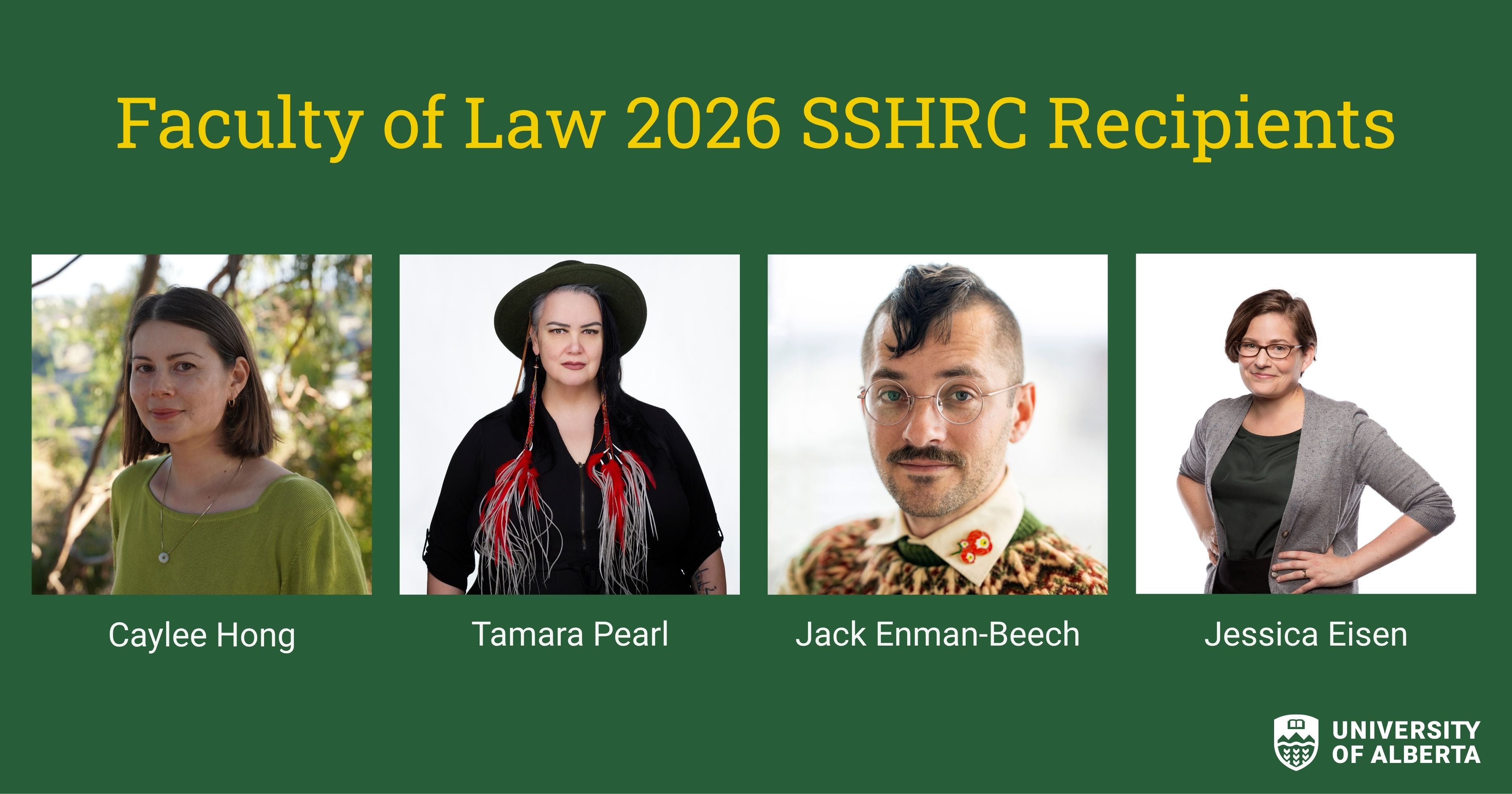
It has been an exceptional year for research in the Faculty of Law, capped off by an impressive success rate in the recent SSHRC Insight Development Grant (IDG) competition. In a powerful testament to the faculty’s thriving culture of research excellence, all three of this year’s grant recipients are early-career and pre-tenure scholars. Additionally, one SSHRC Insight Grant (IG) was awarded.
For a close-knit faculty of roughly 40 members, securing four major grants represents a remarkable achievement. This collective milestone highlights the exceptional calibre of our faculty — particularly our rising generation of scholars — while signaling a vibrant, forward-looking future for our academic community.
Each grant is tailored to a distinct phase of the research lifecycle. The SSHRC Development Grant focuses on research in its initial, early stages — such as formulating new questions or testing methods — offering smaller, short-term funding over one to two years. The SSHRC Insight Grant supports established, large-scale, long-term research programs. Join us in congratulating this year’s IDG and IG recipients:
SSHRC Insight Development Grants:
Dr. Caylee Hong, assistant professor. Project: Frontline municipalities: Decommissioning oil wells in Alberta’s cities. Total funded: $89,633
Dr. Tamara Pearl, assistant professor. Project: Urban Indigenous identity and legal culture in Edmonton and Saskatoon. Total funded: $79,645
Dr. Jack Enman-Beech, assistant professor. Project: Foundations of equity in Canada. Total funded: $34,560
SSHRC Insight Grant:
Dr. Jess Eisen, associate professor. Project: Animal Relations: Maternal Practice, Rupture and Repair. Total funded: $115,553
SSHRC Insight Development Grant
Orphaned wells and the community
“Hundreds of thousands of oil and gas wells are scattered throughout Alberta, including within farms, cities, towns and villages,” explains Caylee Hong, whose project will examine the lasting community impacts of these inactive sites.
“Researchers have identified impacts of oil and gas (O&G) extraction that occur near communities, but this project asks: what happens when active production ends? Despite legal requirements to clean up O&G wells and other facilities, wells often remain unplugged.”
Hong’s project will consider how municipal governments navigate the challenges of idle, orphan or abandoned sites, while assessing how these legacy wells shape public perceptions of the province's energy landscape.
“I am thrilled to receive support to develop an Alberta-specific research project,” she says. “It will bring a local, interdisciplinary lens to a complex, urgent matter facing communities in the province.”
Foundations of equity in Canada
Jack Enman-Beech's project explores the doctrinal and theoretical foundations of equity in Canadian law — the overarching principles that characterize this jurisdiction as a whole.
While the common law operates as a system of formal rights and duties, equity responds to the demands of conscience to prevent the exploitation of vulnerable parties, explains Enman-Beech, adding that, for decades, Canadian legal education and practice have tended to blend these two systems, often obscuring equity’s unique identity. However, recent landmark Supreme Court of Canada rulings have reaffirmed that equity remains a vital, distinct force for ensuring substantive fairness in individual circumstances.
To map this evolving landscape, says Enman-Beech, they will lead a systematic analysis of Canadian case law. This will include evaluating competing theoretical frameworks — examining equity as an expression of moral conscience, a defender of personal autonomy, or a constraint on exploitative power — against actual judicial decisions.
“By synthesizing precedent against this theoretical background, this project will provide legal scholars, practitioners and judges with a clear, principled framework for understanding how equity operates today,” says Enman-Beech
Advancing Indigenous Law
For Tamara Pearl, the grant represents an opportunity to include a “community of voices that may further reconciliation” in her academic work. Her project, Urban Indigenous Identity and Legal Culture in Edmonton and Saskatoon, will explore how Indigenous people living in urban areas have a distinct identity and legal culture that requires further empirical data.
“Such recognition could usefully advance the revitalization of Indigenous law, including Indigenous initiatives that are currently dismissed as ‘pan-Indigenous’ but that actually respond to the ‘pan-colonial’ harms experienced by many urban Indigenous peoples,” explains Pearl, adding that this population continues to be impacted by the effects of assimilative policies from settler colonialism.
As part of the theoretical framing for the project, identity and role theories will be an important consideration, she says, to potentially support generative community-building skills for urban Indigenous people who access services from nonprofits and urban service providers.
“It is encouraging and meaningful to receive funding from SSHRC,” says Pearl. “I am deeply honoured that they see the potential for bettering our communities with my project.”
SSHRC Insight Grant:
Animal Relations and Maternal Practice
Jessica Eisen’s research begins with a stark premise: our legal and societal relationships with animals — particularly farmed animals — are fundamentally broken. To repair this rupture, her research starts with a basic, often overlooked connection: the bond between animal parents and their offspring. By asking foundational questions about how and why animals care for their young, her project serves as a framework and starting point for thinking about our legal, political and ethical obligations towards them.
“The grant allows me to pursue a question I've been circling for years: what would it mean to take animals' maternal and familial practices seriously?” she says. “What might we discover when we explore the ways that human laws shape this core sphere of animal life? And how can we do better? The time is ripe for a reconceptualization of our obligations toward other animals that challenges us to think about our relationships with other animals — and their relationships with each other and their environments — in ways that are both theoretically compelling and popularly accessible.”
Eisen will draw on animal behaviour science, feminist theory and legal analyses to explore how the long-overlooked concept of maternal practice can reshape animal and environmental law and help us ask and answer a new set of questions about animals and our obligations toward them.
"I'm so grateful to SSHRC for the opportunity to ask and answer these questions.”