Convocation 2026: McKenna Mercier, Juris Doctor (JD), Faculty of Law
Donna McKinnon - 4 June 2026
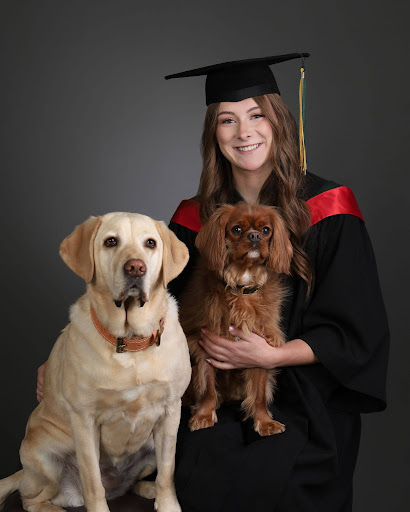
For McKenna Mercier, the journey through law school was less about the letter of the law and more about the lives it touches. While she arrived with an interest in tax law, her path was permanently redirected the moment she stepped into Student Legal Services (SLS). From securing child support for families on the brink of poverty to navigating complex court orders for youth facing addiction, McKenna has spent her degree at the front lines of public interest law.
Known by colleagues for her commitment to work and her "client-first" attitude, McKenna takes her dogs Arley and Squirt everywhere she goes, including SLS. “I think they were more popular than me, and the clients loved them!”
McKenna is a caregiver; both in her family and her community. She has supported victims of domestic violence through her volunteer work with the Emergency Protection Order program, and has worked closely with Legal Aid Alberta in other duty counsel roles, including mental health support and harm reduction initiatives, such as diversionary court programs. She also was a SLS dayleader before becoming the Family Law Coordinator. In these roles she provided free assistance to clients navigating the family court process, including helping draft documents, attend court dates, and in reaching alternative dispute resolutions to avoid further family conflict.
For her advocacy work, particularly for underserved communities, McKenna was recognized with the 2026 Hon. Cecilia Johnstone Equality award, which honours a graduating law student who exemplifies excellence through their commitment to justice and equity.
McKenna’s graduation marks the transition of a student advocate into a formidable legal force — one who views the law not as a career, but as a lifelong commitment to healing trauma and amplifying marginalized voices.
She will begin articling with Legal Aid Alberta in July, where she will continue her advocacy work under the guidance of experienced counsel, hoping to gain experience in child welfare and youth criminal justice to further Indigenous communities’ realization of self-governance over child-welfare.
What led you to choose this area of study, and why the U of A?
I was a stubborn kid and immensely curious, and I was also strong-willed. People told me I’d make a good lawyer when I grew up and I took that to heart. My undergraduate degree in accounting (Bachelor of Commerce) was at the U of A and it made the most sense for my life to stay close to home (and where my dogs were).
Tell us about your favourite professor and/or class.
I was so lucky to have some amazing professors. Dr. Anna Lund had a wonderful approach to teaching and through her classes I got to tour Radius Community Health & Healing Centre where I learned about complex care needs of those with trauma and addiction. We also got to tour NiGiNan Housing Ventures, an Indigenous-led shelter and housing facility for those that are “hard to house”. Every experience and discussion Anna took us through strengthened my passion for justice system reform, particularly for Indigenous people who face systematic barriers to access in every societal structure. Her compassion also taught me the importance of having an advocate for marginalized people who are seeking to reduce the trauma of the legal system. Her approach taught me the value of simple kindness and compassion as a lawyer; the difference that simply treating someone as a human can make when we have such immense power as a profession, particularly a profession that has historically, and presently, perpetuated intergenerational trauma.
In another one of my classes (Low Income Individuals and the Law, a clinical course), I shadowed an incredible lawyer from Legal Aid in a variety of courtrooms and proceedings in matters related to domestic violence, trafficking and financial crimes, and also helping people enter diversionary court programming to address their mental health and addiction needs. All of these experiences have created a deep seated passion for reforming the justice system and understanding the role lawyers and other professionals have in alleviating intergenerational and systemic trauma.
Anna supported me in whatever capacity I needed and never failed to show her students that she cared about us as people. In my clinical placement, a client expressed the value of having clean socks and underwear while unhoused. Because of this, I started collecting hygiene items to ensure they were available to clients who needed them. She was the first to donate, showing up the next day with items for me to distribute. My parents got to meet her at our banquet and my dad, who cannot attend convocation, reflected on his conversation with her as a highlight.
Did you take on any leadership or volunteer roles while you were a student? If so, please share your experiences.
I quickly fell into Student Legal Services (SLS), volunteering in four projects in 1L and working as a dayleader and coordinator of the Family Law Project in 2L and 3L respectively. I got to work on files that had immense consequences for low income people, but who otherwise had no means of access to justice. Our clients were compassionate and patient as we often learned alongside them. Our supervising lawyers also devoted time to mentor us and are the most zealous advocates I have ever met with their own file loads. They would even let me tag along to their court dates, providing me the invaluable opportunity to learn from their skills. They never failed to show up in ways far beyond their roles both for their clients and ours.
I was also blessed with dayleaders who continued to show up even for my crazy ideas and middle of the night emails for the million things I felt had to be done immediately. I can say without a doubt that SLS was one of the most eye-opening and educational volunteer opportunities I have ever had. My experiences at SLS completely changed the goals I have for my career as well as my worldviews. There are no words for the gratitude I have for SLS as an institution, and the clients who have opened their hearts and lives to me. Many of these clients had been failed by multiple systemic barriers, yet they put their trust in me, even when I often did not trust myself. I hope to learn from the stories they generously shared with me to better advocate for meaningful access to justice.
Did you face any significant challenges while you were a student, and if so, how did you respond?
I spent the last seven years as a student at U of A (undergrad and law). In my undergrad, I was a caregiver for both my aging grandparents who passed during the pandemic. In law, particularly in the second and third years of my degree, my role shifted to being a full-time caregiver for my father who has advanced Parkinson’s. He is not able to attend convocation due to his Parkinson’s, but remains the most optimistic person I know — and is a very proud dad (who is also glad all three of his daughters have finally finished school).
What advice do you have for current or future students?
Find ways to do things you love. I’m notorious for studying everywhere, but that flexibility allows me to keep the things I love. I won’t say take a break because I’m notoriously bad at that, and taking a break is really hard when the readings are endless, but make it work. Anyone who knows me, knows my dogs, and I would often bring my computer to dog sports so I could work in between playing with them. Time management and being able to focus anywhere are also super helpful. Find ways to reward yourself for doing whatever it is you need to do. Enjoy good food after a busy study day (whatever good food means to you). It sounds cheesy but try a new hobby. I’m leaving law school having picked up golf and a group of friends from law school who I enjoy golfing with, and I’m so grateful to have that to carry forward.
How do you plan on celebrating convocation?
The last few months there has been an immense amount of change in my dad’s needs, and I’m not in school for the first time since kindergarten. Until the chaos of articling starts, I’ll be either with my dogs, my nieces or at the golf course where I’m working part-time (and hopefully improving my game).
What's next after grad?
I’m spending two months working at the golf course, then I will be articling at Legal Aid Alberta. In that role, I get to shadow more incredible advocates and can only hope the work challenges me as much as SLS and the incredible professors in my law degree program have. From there, I hope to clerk at the Tax Court of Canada with the guidance of my incredible tax instructor, the (now retired) Honourable Justice Don R Sommerfeldt. I hope I can take these skills to focus on advocating for vulnerable parties in family property and support cases, and to reform the barriers that the Indian Act places on Indigenous peoples’ realization of their international human rights. Being a caregiver, and having completely changed the trajectory of my career after working at SLS, has taught me not everything goes to plan, so beyond that, I have no idea what the future holds. All I can hope is to be as passionate an advocate as all of my mentors have been.