Convocation 2026: Daniel Fishman, Juris Doctor (JD), Faculty of Law
Donna McKinnon - 4 June 2026
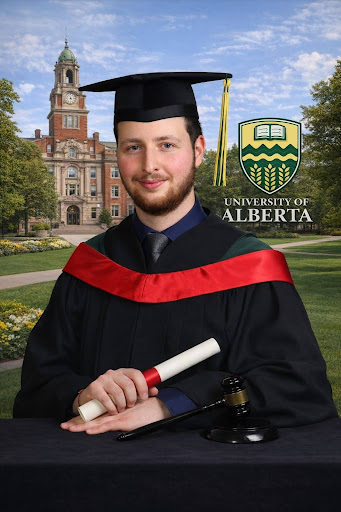
For Daniel Fishman, the U of A’s Faculty of Law was more than a place of study — it was a gateway to the front lines of the legal profession. Believing that a legal education should extend far beyond the library walls, Daniel sought out and participated in an impressive array of practical experiences offered by the faculty, honing his professional skills and broadening his understanding of the law through multiple externships and clinics.
However, it was the courts clerkship course that truly brought the law to life, he says. By shadowing judges and witnessing the real-world consequences of legal principles, Daniel gained a profound appreciation for the power of advocacy and the human impact of the justice system.
Having moved from Ontario to attend law school in Alberta, Daniel quickly immersed himself in the faculty community and later founded the Jewish Law Students' Association, creating opportunities for students to connect with one another and with members of the legal profession.
Daniel will kick off his professional career by articling with Metrolinx this July. He leaves the U of A not just as a skilled advocate, but as a community leader who understands that the law is rooted in connection.
Congratulations Daniel!
What led you to choose this area of study, and why the U of A?
I chose the U of A because of its strong reputation and the exceptional hands-on learning opportunities. During my time here, I had the opportunity to work with the Entrepreneurial Law Clinic, complete an externship with the Office of the Judge Advocate General at the Canadian Forces Base Edmonton, and participate in a court clerkship where I shadowed judges. These experiences allowed me to apply what I learned in the classroom in real-world settings and deepened my interest in the practice of law.
Tell us about your favourite professor and/or class.
My favourite class was the court clerkship course. It stood out because it offered a rare opportunity to step outside the classroom and observe the justice system in action. Hearing real-world stories from judges and seeing how legal principles are applied in practice made the experience especially meaningful.
What I appreciated most was how it bridged the gap between theory and practice. Concepts that can feel abstract in lectures became much more concrete when I saw them play out in real cases, with real consequences for the people involved. Observing the courtroom also gave me a deeper appreciation for the role of judges, the importance of preparation and advocacy, and the professionalism expected of counsel. Overall, it was an experience that not only brought the law to life, but also helped shape how I see my future in the profession.
Did you take on any leadership or volunteer roles while you were a student?
During law school, I took on several leadership and volunteer roles, most notably founding the Jewish Law Students’ Association. In that role, I worked to build a supportive community, organize events and create space for cultural and professional connection within the faculty. One of my goals was to create meaningful connections between students and the broader Edmonton legal community, helping foster mentorship, professional development, and a sense of belonging.
Did you face any significant challenges while you were a student, and if so, how did you respond?
During law school, one of the more significant challenges I faced was relocating to Alberta from Ontario to begin my studies and build a new life away from my established support system. Adjusting to a new province, school environment and being physically distant from my family required a period of adaptation, both personally and academically.
At the same time, I worked part-time with Alberta Blue Cross for two years after they took me on as a summer student for the 1L summer, which added another layer of responsibility alongside a demanding program. Early on, it took effort to find a sense of community and belonging in a new place, but I made a conscious effort to get involved, build relationships and engage with the law school community.
Over time, I was able to establish a strong support network and a sense of community in Alberta. These experiences helped me develop resilience, independence and adaptability, and reinforced the importance of connection and support systems in successfully navigating challenging periods.
What advice do you have for current or future students?
My advice to current and future students is to focus on building strong, sustainable habits early on, rather than trying to rely on short bursts of productivity during high-pressure periods. One of my favourite professors, Dr. Anna Lund, often emphasized the importance of establishing healthy routines early in the academic year so that you have strong habits to rely on when things become more challenging.
I also think it’s important to take advantage of opportunities outside the classroom, whether through clinics, internships, student organizations, or extracurriculars, as these experiences help connect theory to practice and clarify your interests.
Don’t underestimate the importance of community. Build relationships with your peers, professors and mentors, and don’t be afraid to lean on that support system when things get challenging. Those connections often end up being just as valuable as the academic experience itself.
How do you plan on celebrating convocation?
I plan on celebrating convocation by spending time with family and friends who have supported me throughout law school. My family is based in Ontario, so I’m especially looking forward to celebrating together in person after a long period of being away from home.
I also plan to take some time to slow down and reflect on the journey before moving into the next chapter. After a busy and demanding few years, it will be nice to step back and really take in the accomplishment.
In addition, I’m looking forward to getting back into a few personal interests that I haven’t had as much time for during law school — playing golf and returning to competitive shooting. Overall, it will be a mix of celebrating with the people closest to me, recharging and enjoying some activities I’ve missed along the way.
What's next after graduation?
After graduation, I’ll be moving back to Ontario in June to be closer to my family. In July, I will begin articling with Metrolinx, where I’m looking forward to gaining practical experience and building on the skills I developed throughout law school. Following that, I will be writing the bar exams in November as the next step toward becoming a practicing lawyer.