Adam Gareau earns Supreme Court Clerkship
Carmen Rojas - 15 April 2026
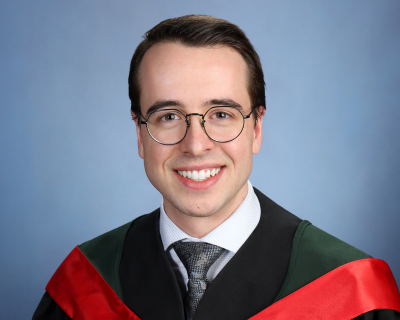
For Adam Gareau, the defining moment of his law school career came in the middle of a high-pressure competition.
In late February, Gareau was in Toronto competing in the Laskin Moot when he felt his phone vibrating in his suit pocket. When he finally had a moment to check his messages, he found a voicemail from Justice Malcolm Rowe offering him a clerkship at the Supreme Court of Canada—one of the most prestigious appointments for a law graduate.
“After we finished our oral arguments, I ran out of the courtroom and called back,” Gareau says, describing the conversation as “surreal.” “It was an exciting morning.”
The appointment will see Gareau relocate to Ottawa in 2027, where he will spend a year assisting Justice Rowe with legal research and the preparation of memoranda.
On the morning of the phone call, his immediate challenge was to refocus on the task at hand: the Laskin, an annual bilingual competition in administrative and constitutional law.
Gareau made the transition seamlessly. Less than 24 hours after accepting the clerkship, he claimed the competition’s Best Oralist honour, punctuating a weekend of back-to-back career milestones.
Bridging engineering and law
Gareau’s ability to balance complex moving parts has served him well throughout a rigorous and unconventional academic journey.
Before pursuing law, he completed a degree in mechanical engineering at the U of A, and since starting his legal education, he has kept a foot in both worlds. For the past three years, he has balanced his studies in the JD program with part-time work as an engineer in training for the Hudson Bay Railway.
While the pivot from engineering to law may seem unusual, Gareau sees clear overlap between the two.
“As an engineer you crave certainty and clear rules,” he explains. “That’s something I’m always trying to figure out in law: What is the rule from this case? What is the thing I can actually go and apply? [My engineering background] is very helpful in that sense.”
It was also Gareau’s experience in the Faculty of Engineering's co-op program that originally piqued his interest in law. When one of the companies he worked for was dealing with litigation, he was fascinated by the process. He also noticed how the lawyers needed to study the nature of the engineering problem in order to tackle the case.
“I realized my engineering knowledge might be something I could leverage if I ever went to law school,” he says.
Balancing engineering work with legal studies has made for long days, but Gareau says the key to his success is simple: he enjoys both.
“I love my job. It’s a smaller company so the responsibilities are varied; I do tons of different things,” he says, noting that it’s taken him to places like Churchill, Manitoba (where he saw beluga whales in the bay) and to Whitehorse, Yukon for a permafrost conference.
At the same time, his experiences in law school introduced him to new areas of interest – from reading fascinating case law in first year to honing his written and oral arguments for moot competitions in second and third year. He also studied under influential professors like Gerard Kennedy, a mentor who encouraged him to apply for the Supreme Court clerkship.
“One of the things I like about law school is you need to use your memory for more than just being correct on every single line of calculations like you would on a math assignment,” he says. “Your intuition matters more than necessarily getting the right answer.”
Looking ahead
With graduation approaching, Gareau is focused on the immediate future. The next few years will take him from a clerkship at the Alberta Court of Appeal to the Supreme Court of Canada, before a likely return to Edmonton to complete his articles.
And while he envisions a career that bridges his technical and legal expertise—developing a litigation practice that draws on his engineering background—he remains open to where that combination might lead. “Who knows where my career will take me?” he says, a mindset that has already carried him from engineering classrooms to the country’s highest court.