Student spotlight: Ansh Gulati, JD candidate at the University of Alberta
17 March 2026
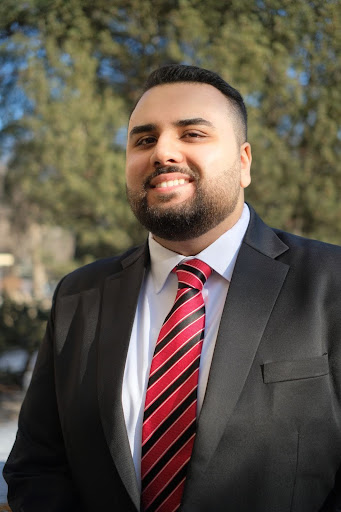
An enthusiastic participant in all the faculty has to offer, Ansh Gulati is a student in the Faculty of Law who looks forward with eager anticipation to the challenges of the legal profession, and to the impact he hopes to make once he graduates.
Gulati, who was the top political science graduate of his year, obtained a bachelor of arts with distinction prior to entering law school. His passion for global issues also prompted him to pursue a certificate in international learning during his busy undergraduate years.
Gulati's momentum has continued on the national stage, after placing first in every round of the National Canadian Client Consultation Competition in Victoria — an opportunity that is fully funded by the faculty — he has earned the honour of representing Canada at the international level. We spoke with Gulati about some of the highlights of his time in the Faculty of Law so far. He shares the wisdom and perspectives he has earned through several experiential learning opportunities offered by the faculty.
Why did you choose the U of A for law school?
The faculty is incredibly prolific; it’s a unique experience to study from textbooks written by the very professors teaching your classes.
The faculty also has a remarkable support network, which creates an environment where students are truly supported and able to thrive.
I knew I wanted a school that wouldn’t just teach me the theory of law, but how to actually practise it. The emphasis on experiential learning opportunities was a huge draw for me.
What can you share about those opportunities?
I have tried to make the most of the experiential opportunities our faculty offers! I am currently pursuing the Entrepreneurial Law Clinic and have been involved in multiple divisions of Student Legal Services.
This hands-on legal work has been a perfect complement to the mooting program under Chris Samuel, which is a class apart. I represented our faculty in the Health Law Moot, where our team took home the trophy. Building on that foundation, I recently represented the faculty in the National Client Consultation Competition. With the support of my partner, Jasmine El-Issa and our coaches, we managed to place first in every round — preliminary, semi-finals, and finals — ultimately taking home the national title. I feel honoured and excited to represent the U of A and all of Canada at the International Client Consultation Competition in Croatia!
I have also had the opportunity to take up a legal student placement with the Edmonton River Valley Conservation Coalition, which has been a highlight.
Tell us more about how that came about.
I was initially connected to the coalition through Adebayo Majekolagbe, someone whose mentorship I am incredibly grateful for. My placement extended beyond its original scope, allowing me to work directly with the board of directors and deepen my contributions. I conducted comprehensive research and legal and statutory analysis, distilling technical information into actionable recommendations, which I then presented to city council. That presentation and responses were even covered in CBC and other media, and I authored an op-ed in the Edmonton Journal. All of this was a true taste of how the application of the law can make an impact on an organization and the broader community.
How did that experience affect how you see your future in law?
That experience was a turning point because it moved the law out of the textbook and into the realm of real-world consequence. I realized my research and my words had a direct impact on the organization's reputation and the community’s future.
It taught me that being a lawyer is about carrying the weight of accountability. Whether I am representing a corporate client in a merger, advising a government body, or advocating in court, the core responsibility is the same: The client is entrusting you with their most critical interests.
This experience helped me realize my capacity to handle that pressure, to be meticulous in my preparation and to take full ownership of the outcomes. It shifted my focus from just “learning the law” to “applying the law” with the high level of professional discipline required in any practice area.
Your op-ed reflects an interest in Indigenous rights. How would you like your future career to reflect that passion?
Coming from a background shaped by colonial legacies, I have always foregrounded the importance of educating myself to better serve my fellow Treaty people. I truly believe reconciliation is an ethical commitment that must be embodied in our everyday actions.
I am acutely aware that the law is still viewed with suspicion by many Indigenous Peoples; however, the law does not have to be oppressive or an obstacle to reconciliation. Instructors like Koren Lightning-Earle have helped me understand the importance of acting in ways that help to rebuild trust where systems have historically failed. My commitment to justice requires me to not only recognize biases but to actively work toward a more equitable legal system that reflects Canada’s diverse society and respects Indigenous legal traditions and knowledges. As a practitioner, I hope to carry this ethical commitment forward by continuing to learn, listening carefully and approaching this work with accountability and humility.
What would you say to other law students considering experiential learning?
Experiential opportunities are the bridge between theory and practice, and under Dean Fiona Kelly's direction, this philosophy has truly been brought to life through diverse and meaningful opportunities for hands-on learning. I still vividly remember practising for the moot in a boardroom full of lawyers ready to grill us. When they commented that we were undergoing the same preparation their top litigators face, it was both humbling and deeply satisfying.
Actively seeking out opportunities like that has given me a taste of the rigour required in this profession and has been one of the most rewarding aspects of my legal education. The degree is truly what you make of it.
Curious about the experiential learning opportunities offered by the Faculty of Law? Learn more here.