Laying a Legal Foundation
8 January 2026
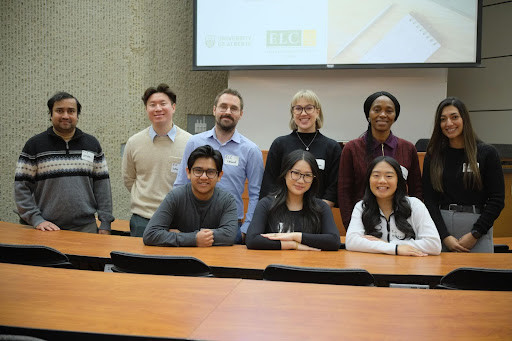
To support Edmonton's startup community, the Entrepreneurial Law Clinic (ELC) recently hosted a well-attended "Lunch and Learn" session, providing free legal guidance to entrepreneurs and small businesses.
ELC caseworkers — law students Monisha Kingra, Victor Yoon and Palaash Gupta — led the session, first providing an overview of the legal aspects of different business structures and intellectual property, and then answering questions from attendees.
“Far too many promising ventures stall because they are overwhelmed by the legal costs, the unfamiliar terminology in law books, and the complex processes of starting a business,” said Uchenna Ugwu, an assistant lecturer who oversees the clinic. “That is where the ELC comes in, and that is how we can be helpful to you.”
Tip #1: Start simple with sole proprietorship
Sole proprietorship – a business that is owned and operated by one person – is a great way to start a small business or test a new idea to see if it gains traction with your target audience. This structure is simple, inexpensive to set up and allows you to maintain full control of your business.
However, sole proprietorships have one major disadvantage: you carry unlimited personal liability. This means all debts and legal liabilities extend to your personal bank accounts and assets.
Tip #2: When your risk rises, protect yourself with incorporation
Once a business incurs a significant amount of risk or revenue growth, they should consider moving to a more complex structure, like incorporation, suggests the ELC.
Corporations - which consist of shareholders, directors and officers- can exist as their own separate legal person. This means the corporation is an independent taxpayer, can own property in its own name, enter into contracts, and sue and be sued while existing as a stand alone entity.
One of the biggest advantages of incorporating your business is limited liability. Shareholders are only liable for the amount they’ve invested. It’s also easier to raise capital since corporations are able to issue shares to investors, rather than bringing on additional partners.
Since corporations are more complex than partnerships, they’re subject to more regulation and higher administrative costs, but this structure often makes more sense for businesses that carry higher risk or want room to grow and raise more capital.
Tip #3: Put it in Writing
A partnership is a relationship between people running a business, and in Alberta there are three main types: a general partnership, a limited partnership and a limited liability partnership.
Like sole proprietorships, partnerships are a relatively easy and inexpensive way to get started. They’re a good option for small groups who trust each other and want to start a business without the formality of incorporation.
They also carry the risk of personal liability, however, and the potential for conflict among partners. In light of this, the ELC stresses the importance of having a proper written Partnership Agreement. They also recommend having a full understanding of your liability exposure and choosing a structure that best fits your risk tolerance.
Tip #4: How to market your early-stage idea
When it comes to intellectual property, patents and trademarks are the areas that matter most to founders. Patents protect new and useful inventions, while trademarks protect the brand (names, logos and slogans) used to distinguish your business from others.
Obtaining a patent in Canada can take 20 to 30 months, but the application stage has advantages as well. Once you receive official “patent pending” status it can be used as a marketing tool, as well as to deter competitors and attract investors.
Similarly, registered trademarks are valuable assets for any company. They make licensing easier, can increase company valuation and signal to investors that a brand is protected and enforceable.
If you are interested in applying to become a client of the ELC, more information and an application form can be found here.